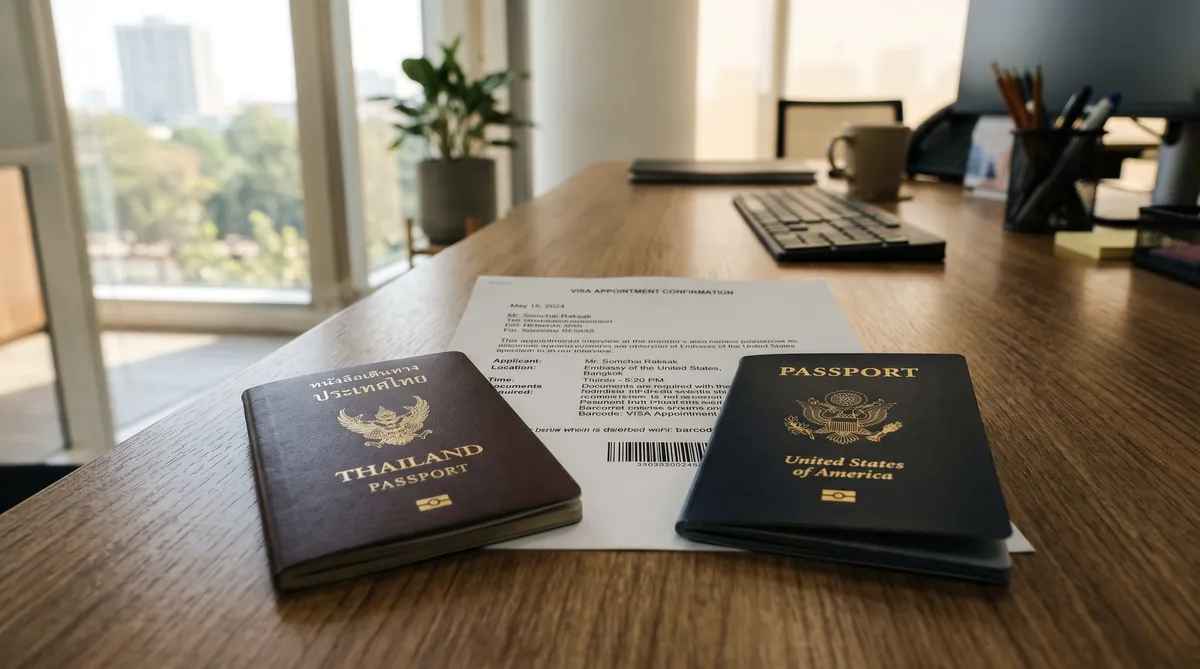

The headline: On 8 May 2026, the European Commission approved the Visa Cascade regime for Thai nationals residing in Thailand. The EU Delegation in Bangkok confirmed the change on 18 May. The Royal Thai Ministry of Foreign Affairs (MFA) announced it a day earlier, on 17 May. Thai travellers with a clean prior-Schengen track record can now qualify for multiple-entry visas (MEVs) valid for one year, then two years, then up to five.
Thailand becomes the seventh country in this regime, after India, Saudi Arabia, Bahrain, and Oman in 2024, and Turkey and Indonesia in 2025. It is also the second ASEAN country to be granted the cascade.
Thailand qualified on its track record. Thai nationals filed 265,243 Schengen applications in 2024 with a refusal rate of about 6.2%, well below the global average of 14.8% reported by the European Commission. The Commission’s evidence-based assessment, referenced in the European External Action Service (EEAS) announcement, found Thai applicants present low migration and security risk.
This is the most significant change in Schengen policy for Thai travellers in over a decade. It is also the part that most coverage is getting subtly wrong.
What the cascade actually is
The cascade is not a visa exemption. The Schengen application process has not changed. What has changed is what the embassy can issue when you qualify.
How Thailand’s cascade compares to other recipient countries
Each cascade country gets its own bespoke set of thresholds. The EU Commission does this through country-specific Implementing Decisions under Article 24(2d) of the Visa Code. The thresholds are calibrated to the local risk profile, application volumes, and economic context, which means Thailand’s cascade is genuinely different from the others.
Schengen Visa Cascade by Recipient Country
Each country's cascade is set by its own EU Commission Implementing Decision under Article 24(2d). Thresholds reflect risk profile and application volume.
| Country | Year | 1-year MEV | 2-year MEV | 5-year MEV | Vs. Thailand |
|---|---|---|---|---|---|
| Thailand | 2026 | 1 visa in past 2 years | Use of 1-year MEV | Use of 2-year MEV | Baseline |
| India | 2024 | Skipped | 2 visas in past 3 years | Use of 2-year MEV | Faster to 2-year |
| Indonesia | 2025 | Skipped | Skipped | 1 visa in past 3 years | More lenient |
| Saudi Arabia | 2024 | Skipped | Skipped | First-application eligible | Most lenient |
| Turkey | 2025 | 1 visa in past year (6-month MEV) | Use of 1-year MEV | Use of 3-year MEV | More tiers, stricter |
Source: EU Commission Implementing Decisions per country (2024-2026), EEAS announcements, and EUR-Lex Regulation (EU) 2019/1155.
Thailand’s cascade is the standard three-step ladder, with a relaxed entry threshold. It is more accessible than Turkey’s stepped progression but less generous than Saudi Arabia’s first-application 5-year. The Implementing Decision for Thailand is legally binding on every Schengen member state.
How the cascade actually works
The default text of Article 24(2) of the Visa Code, as amended by Regulation (EU) 2019/1155, requires three prior visas in two years to qualify for a 1-year multiple-entry visa. The Thailand-specific Implementing Decision relaxes this. Under the new rules, a Thai passport holder qualifies for:
Thailand's Schengen Cascade Ladder
Three tiers, each unlocked by lawful use of the previous tier.
Source: European Commission Implementing Decision for Thailand, adopted 8 May 2026. Eligibility is mandatory under Visa Code Handbook I §8.4.3.1 when conditions are met.
EU Visa Code Handbook I Point 8.4.3.1 states that the escalation “shall” be applied when the conditions are met. It is mandatory by default. Consuls keep a narrow discretion to shorten the validity in individual cases where there is “reasonable doubt that the entry conditions will be met for the entire period,” for example when the applicant’s work contract or residence permit expires earlier than the cascade tier.
The cascade does not change the 90/180 day stay rule. It changes how often a qualifying traveller has to reapply.
What “good travel record” really means
Embassies do not ask Thai applicants to declare a good travel record. They verify it through the EU’s shared Schengen visa records, which hold fingerprints and prior visa decisions across all member states. Applicants do not see this database, but it shapes every decision.
The disqualifying grounds come from Article 32(1) of the Visa Code, which lists 15 refusal grounds. A handful of them carry forward into cascade eligibility.
Article 32(1) Refusal Grounds
The 15 grounds for refusing a Schengen visa application. The Visa Information System retains the record for up to 59 months.
Source: Regulation (EC) 810/2009, Article 32(1), as amended by Regulation (EU) 2019/1155. Highlighted grounds reflect those most load-bearing on cascade eligibility per the EU Visa Code Handbook I.
Past overstays show up in the EU’s shared visa records and weigh on every subsequent application. Prior refusals under Article 32(1)(b), the “doubt about intention to leave” ground that is by far the most common reason Thai applicants are refused, continue to weigh until the underlying circumstances change. Document-authenticity doubts, fraud indicators, and entry refusals at a Schengen external border are all recorded against the passport, not the visa. Our existing Schengen visa guide for Thai nationals covers each of these refusal grounds and how Bangkok consulates apply them in practice.
The European Commission’s Eighth Report Under the Visa Suspension Mechanism (December 2025) confirms the EU monitors cascade-recipient countries and retains the right to suspend the regime. The 2026 EU Visa Strategy frames cascade as a reward for “visitors with a proven travel history.” It is a recognition that compliance has been earned, not a relaxation of standards.
Who is eligible right now
Eligible today: Thai nationals who hold or have held a Schengen visa within the previous two years and used it without compliance issues.
Practically excluded today: Thai applicants whose only prior visa was refused, whose prior visa was never used (because “lawful use” requires actual entry), or who have a documented overstay or violation on file.
First-time applicants are a special case. The cascade ladder needs a prior Schengen visa to start, so a typical first-time tourist will not get a long-validity MEV. There is one exception. Under Article 24(2c) of the Visa Code, an embassy can still issue a multi-year MEV to a first-time applicant with substantive institutional backing: a corporate executive on company business, a non-governmental organisation (NGO) sponsoring a humanitarian worker, a journalist on assignment, or a human rights defender. The bar is high. Earning a lot of money or working for a well-known company does not, on its own, qualify.
For everyone else, the cascade still matters on a first application. Every clean file submitted from May 2026 forward is the first rung on a potential five-year ladder. Preparing well today is now a multi-year investment, not a single-trip cost.
If your partner is an EU citizen
Thai spouses and family members of EU citizens get preferential treatment under the EU’s free-movement rules (Directive 2004/38/EC). Embassies are explicitly told not to assess the family member’s finances or whether they intend to return. Long-validity MEVs are prioritised for this group. This applies only to EU-citizen partners. It does not apply to American, British, or Australian partners, who fall outside EU free movement. For European-partner cases, this is one of the most material changes the cascade brings.
The Bangkok embassy question
Cascade eligibility is determined by Schengen-wide records, but the issuing decision is made by an individual embassy. That matters.
In 2023, approval rates at Bangkok’s Schengen consulates ranged from 97.5% at the Austrian embassy and 97.3% at the Swiss embassy down to 83.3% at the Swedish embassy (European Commission consulate-level data). The cascade does not change Article 32 refusal grounds and does not equalise these rates.
The first batch of cascade decisions will work through Bangkok consulates over the next 8 to 12 weeks. Until then, the pre-cascade MEV issuance rate of 44.6% across Thailand-based consulates in 2023 (per the European Commission’s Directorate-General for Migration and Home Affairs, DG HOME) is the most honest baseline.
What the cascade changes, and what it does not
The cost arithmetic shifts meaningfully. The Schengen visa fee is €90 for adult applicants, plus VFS Global or TLScontact service-centre fees of roughly 900 to 1,400 THB depending on the visa centre. Pre-cascade, a Thai traveller making five trips to Europe over two years applied five separate times. Under a 2-year MEV, that traveller submits once.
Cost Arithmetic: 5 Trips Over Two Years
€90 visa fee + ~900-1,400 THB service-centre fee per application. Approximate totals in Thai baht.
Savings: ฿18,400 (80% less) over 5 trips
Assumes typical VFS Global or TLScontact service-centre fees. Schengen visa fee is €90 for adult applicants. Source: EU Commission, VFS Global Thailand, TLScontact Thailand.
What the cascade does not change matters just as much. The Schengen application process is unchanged. The documentary requirements are unchanged: proof of accommodation, sufficient means, travel medical insurance with minimum €30,000 coverage, ties to Thailand, and a credible purpose of travel. The 90/180 day stay rule applies in full. The embassy retains the right to refuse the application at any time, regardless of cascade eligibility. The visa fee is unchanged. The “main destination” rule for choosing which embassy to apply to is unchanged.
Cascade lengthens the validity, increases the entries, and recognises a track record. It does not lower the bar.
What this means over a five-year horizon
For a Thai traveller filing their first Schengen application now, every successful, compliant trip is part of a longer arc. The next application is no longer a one-off renewal. It is the second rung of a ladder that ends in a five-year multi-entry visa.
For couples planning recurring European travel, that changes the calculus. Each application now compounds toward something longer-term. This is the quiet shift the cascade introduces.
Frequently asked questions
Does the cascade apply to first-time Schengen applicants?
Generally no for typical tourist applicants, who need a prior compliant Schengen record to enter the cascade ladder. Article 24(2c) keeps a discretionary path open for institutional first-time applicants (vetted corporate, NGO, journalist, or research sponsorship), but the threshold is substantive. For the standard first-time tourist, the cascade rewards the next application.
Can I get a 5-year Schengen visa on my second application?
Not under Thailand’s specific cascade. The Thailand Implementing Decision sets out a three-step ladder: 1-year first, then 2-year on the next eligible application, then 5-year on the application after that. Each step requires lawful use of the prior tier.
What counts as “lawfully used”?
Entry into the Schengen area within the visa’s validity, departure within the permitted stay, and no recorded violations of Visa Code conditions. Embassies verify this through the EU’s shared Schengen visa records, which hold fingerprints, prior visa decisions, and entry-and-exit data across all member states.
Does cascade apply at all Schengen embassies in Thailand?
Yes. The Article 24(2d) Implementing Decision is legally binding on every Schengen member state. Approval rates and validity decisions vary by embassy in practice, but eligibility is determined by EU-wide rules.
Do I need to give fingerprints again for each cascade application?
It depends on the embassy. If you have given fingerprints for a recent Schengen visa, many embassies will reuse them for your next application. Some will ask for fresh prints anyway, for example if the previous data quality was poor, identity needs to be reverified, or the embassy has its own policy. Confirm the requirement directly with the embassy or visa centre you plan to apply through.
Can the cascade be revoked?
Yes. The Visa Suspension Mechanism allows the Commission to suspend visa-policy benefits in response to migration, security, or compliance concerns. As of May 2026, no country has had its cascade specifically revoked.
Does the cascade apply differently if my partner is an EU citizen?
Yes. Thai family members of EU nationals exercising free movement rights receive preferential treatment under Directive 2004/38/EC. When applying cascade rules, consulates do not assess the family member’s economic situation or intention to leave. This applies to EU-citizen partners only, not US, UK, or Australian partners.