The headline numbers: The Schengen visa rejection rate for Thai nationals in 2024 was 6.2%, less than half the global average of 14.8%. But that headline hides dramatic variation between Bangkok embassies. The Austrian embassy approves 97.5% of Thai applications. The Swedish embassy approves only 83.3%. All apply the same EU Visa Code; they just interpret it differently. Processing takes about 15 working days from the appointment date, with 7 to 10 days of document preparation before that. The standard adult visa fee is €90. The most common denial reason for Thai applicants is doubt about intention to return, not insufficient funds.
May 2026 update: Visa Cascade approved for Thai nationals
The EU has approved a Visa Cascade for Thai passport holders. Eligible travellers can now qualify for 1, 2, and 5-year multiple-entry Schengen visas based on prior travel history. Read the full cascade breakdown →
A Schengen visa opens 29 European countries on a single application. Thai nationals had a 93.8% Schengen approval rate in 2024 (European Commission data), but that headline number hides real variation. Schengen visa requirements for Thai nationals vary by embassy, and the details matter more than most online guides suggest.
Before we advise any client, we want to understand their specific situation: the destination, the relationship, the timeline, the documents they already have. That’s how we’ve approached Schengen cases from our office near BTS Udom Suk since we opened. This guide walks through what we look at and why: which embassies approve at different rates, why “show more money” is usually the wrong advice, and the one document that delays more applications than anything else.
If You’re the European Partner
If you’re reading this because you want to bring your Thai girlfriend, boyfriend, or spouse to visit you in Europe, this guide is written with your situation in mind. The Schengen visa application is filed by the Thai national, but the European partner plays a critical role in the process.
What you’ll need to provide from your side:
- Invitation letter from your local government office. In Germany, this is the Verpflichtungserklärung from the Ausländerbehörde. In France, it’s the attestation d’accueil from your mairie. This is the single biggest delay in most applications because the original must be physically mailed to Thailand. Start this process early. (Hungary and Switzerland are exceptions: a personal letter is sufficient.)
- Proof of your financial ability to host. Payslips, employment contract, or bank statements showing you can support the visit. Requirements vary by country.
- Proof of your relationship. Photos together, chat history, records of previous visits, flight bookings showing trips between your countries. The embassy is assessing whether the relationship is genuine.
- Your accommodation details. Proof that your partner has somewhere to stay, whether that’s your home address with a utility bill or hotel bookings.
The timeline from your side is usually 2-4 weeks to get the invitation letter processed and mailed. On the Thai side, document preparation takes 7-10 working days, and embassy processing takes about 15 working days. Plan for 6-8 weeks total from start to passport back in hand, longer during peak season (January through April).
If your partner has never traveled to Europe before, the first visa will likely be single-entry with a short validity. That’s normal. Each successful trip builds travel history, and after a few clean entries and exits, longer multi-entry visas become available.
We work with both partners throughout the process. You can reach us directly, and we’ll coordinate what’s needed from each side. Many of our Schengen clients are couples where the European partner contacts us first.
One Visa, 29 Countries
The Schengen visa is a short-stay visa that allows travel across 29 European member states for up to 90 days within any 180-day period. One application, one fee, access to most of Western and Central Europe.
The member count matters because it changed recently. Bulgaria and Romania joined the Schengen area in 2024, and Croatia joined in 2023. Many online guides still say 26 or 27 countries, so if your Thai partner is planning a trip that includes any of these newer members, make sure the information you’re reading is current.
The full list: Austria, Belgium, Bulgaria, Croatia, Czech Republic, Denmark, Estonia, Finland, France, Germany, Greece, Hungary, Iceland, Italy, Latvia, Liechtenstein, Lithuania, Luxembourg, Malta, Netherlands, Norway, Poland, Portugal, Romania, Slovakia, Slovenia, Spain, Sweden, and Switzerland.
One clarification that comes up often: as of early 2026, ETIAS, the European travel authorization system, has not yet launched and does not apply to Thai nationals. Thai passport holders still need a standard Schengen visa. And the Schengen visa does not cover the UK, Ireland, or Cyprus, which each require separate applications with different requirements and processing timelines.
Which Embassy Do You Apply To?
You apply to the embassy of your main destination, meaning the country where your Thai partner will spend the most nights. If the trip splits time equally between two or more countries, you apply to the country of first entry. Getting this wrong means a rejection before anyone even looks at the documents.
We’ve seen applications turned away because the applicant chose the wrong embassy for a multi-country itinerary. A trip that starts in Paris but spends most nights in Rome should go through the Italian embassy, not the French. It seems like a small detail, but it can set things back by months.
When we help clients plan their itinerary, we recommend structuring the trip so the primary destination is also the first country of entry whenever possible. This simplifies the embassy selection and also makes the arrival smoother: if you land in the country that issued your visa, immigration is straightforward. Landing in a different Schengen country first can prompt questions about why you’re entering there when your visa was approved elsewhere. It’s not a dealbreaker, but it’s one small consideration that’s easy to plan around.
In Bangkok, Schengen visa applications are submitted through third-party processing centers: VFS Global Bangkok, TLS Contact Bangkok, or BLS International, depending on the destination country. Each has its own appointment system and submission process. We coordinate the appointment and handle the submission at the relevant center on your behalf. It’s worth understanding that submitting through these centers is just one step. The center forwards the application to the relevant embassy, where consular officers review it and make the final decision. In some cases, the embassy may request an additional interview before deciding, or flag issues that need clarification. The processing center handles logistics; the embassy handles the outcome.
The most popular Schengen destinations our clients apply for: France, Germany, Switzerland, Italy, the Netherlands, Austria, and Belgium, roughly in that order.
One thing that catches people off guard: Croatia’s Schengen visa is processed through the embassy in Jakarta, not Bangkok, which makes the application process quite different from other Schengen countries. This is the kind of detail that doesn’t appear on most visa checklists. (V Goal does not currently process Croatia visa applications for this reason.)
Timing matters too. Applications can be submitted up to 180 days before travel. We recommend starting 1-2 months in advance. January through April is peak season. Clients planning European summer trips, couples scheduling visits around Songkran, and last-minute holiday planners all compete for the same Schengen visa Bangkok appointment slots at VFS and TLS. That window fills up fast.
What Documents Are Required?
Thai nationals applying for a Schengen visa in 2026 need: a valid passport (valid at least three months beyond the departure date), Schengen travel insurance with minimum €30,000 coverage, six months of bank statements, an employment letter confirming approved leave, proof of ties to Thailand, round-trip flight bookings, accommodation confirmation, and a day-by-day itinerary. If visiting someone in Europe, an invitation letter from the European sponsor is also required.
The document list for a Schengen visa is long, and the specifics shift depending on which embassy you’re applying to. Here are the major categories.
Passport. Must be valid for at least three months beyond the intended departure from the Schengen area, and not older than ten years. At least two blank pages.
Travel insurance. A policy with minimum €30,000 medical coverage is mandatory. We arrange Schengen-compliant travel insurance as part of our service, so it’s not something your partner needs to sort out separately.
Financial documentation. Bank statements showing at least six months of consistent activity. Both salary income and savings strengthen the case. The key word is consistent. Embassy officers review the full six months of transaction history, and they know what borrowed money looks like. If someone deposits a large sum just before applying, it stands out immediately, even if the money is legitimately theirs. What officers want to see is a steady pattern: regular salary coming in, normal spending going out, and a balance that makes sense for the applicant’s income level. Building that picture over months is far more convincing than any single number.
How much is enough? That depends heavily on which embassy is reviewing the application. Some embassies are satisfied with modest savings that match the applicant’s lifestyle. Others, particularly in Northern Europe, expect significantly more. The gap between what different embassies consider adequate is one of the reasons preparation matters. We assess each client’s financials against the specific embassy’s expectations before submission.
Proof of ties to Thailand. This is the most misunderstood requirement. It’s about demonstrating real reasons to return: steady employment with an HR letter confirming approved leave and a held position, property ownership, family responsibilities in Thailand. It’s not a long checklist. It’s about painting a clear picture of stability through work, savings, and roots.
Accommodation and flight bookings. Confirmed hotel reservations or a letter from a host, plus a flight itinerary.
Biometric data. Collected in person at the visa application center.
The Core Documents
At a minimum, expect to prepare: a valid passport, the completed application form, passport photos, Schengen-compliant travel insurance, six months of bank statements, an employment letter, proof of ties to Thailand, round-trip flight bookings, accommodation proof, and a day-by-day trip itinerary. If your Thai partner is visiting someone in Europe, add the invitation letter from the European sponsor.
That covers the core categories, but the specific documents, formatting, and supporting evidence vary by embassy. Some require additional items that aren’t on any standard list (for example, Switzerland’s embassy in Bangkok publishes its own detailed requirements). We prepare the complete package tailored to the specific embassy handling your application.
The Invitation Letter: The Most Common Delay
For visitor visas where someone in Europe is sponsoring the trip, the sponsor must obtain a formal invitation letter from their local government office (a Verpflichtungserklärung in Germany, an attestation d’accueil in France). The original document has to be physically mailed to Thailand. This single step is where we see the most delays.
Your partner can have every other document ready, and the application still waits on a piece of paper crossing international mail. We’ve had cases where everything was prepared in under a week, but the invitation letter took three.
Two exceptions: Hungary and Switzerland allow the sponsor to write the invitation letter themselves without government involvement. For every other Schengen country, it goes through an official office.
This is one of the reasons we tell clients to start this process early. The invitation letter can sometimes be the thing that slows everything else down.
Why Applications Get Denied: The Data Says Something Different
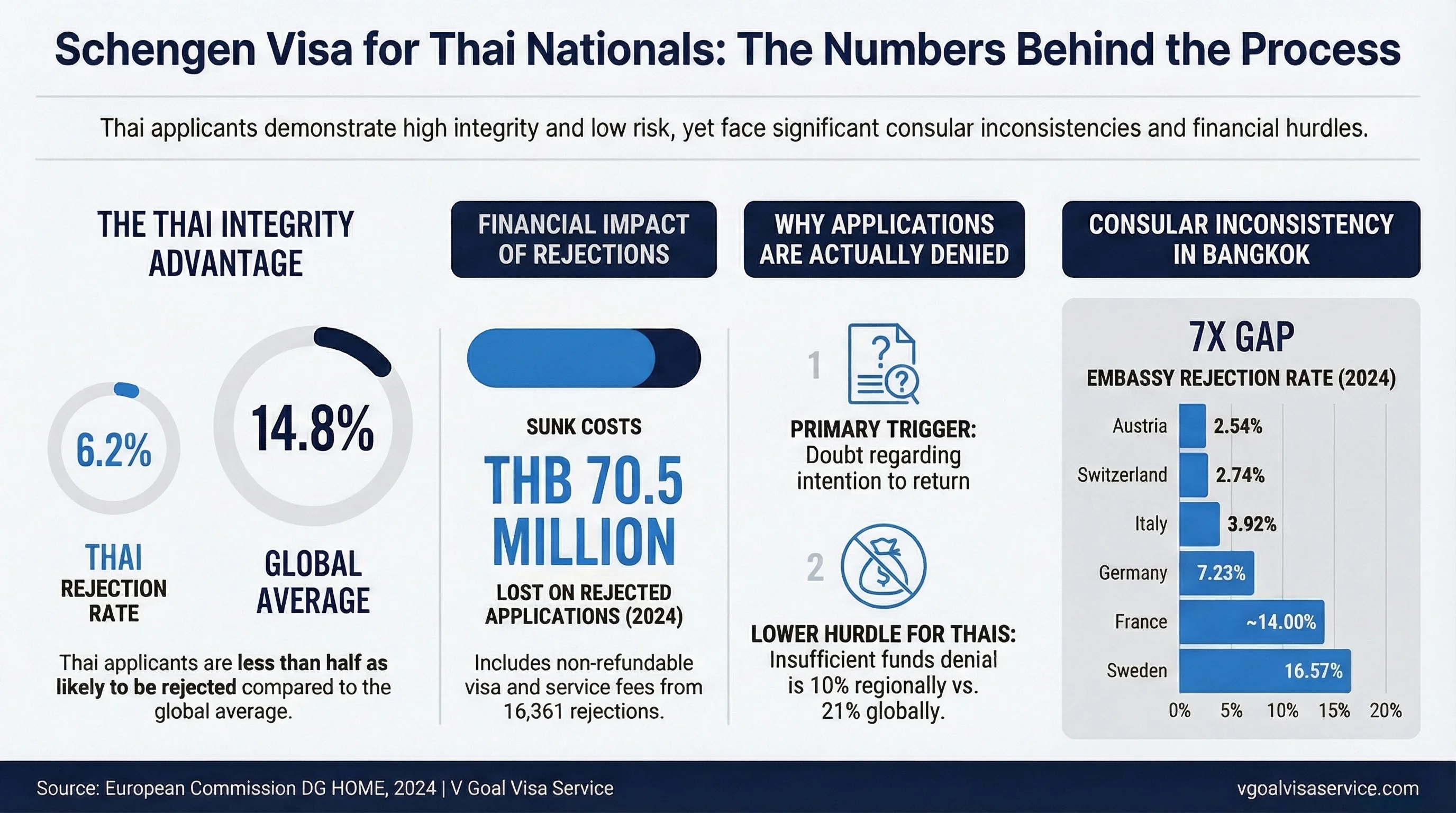
The Schengen visa rejection rate for Thai nationals was 6.2% in 2024, less than half the global average of 14.8%. That rate has improved from 9.9% in 2019 to 6.2% in 2024, even as global rejection rates climbed. Out of 265,243 applications from Thailand, 16,361 were refused.
For context: Thai applicants face a 22.50% refusal rate on US tourist visas (FY2024, US State Department data), more than three times the Schengen rate. UK visitor visa refusal rates for Thai nationals were 9.7% in 2025 (5,399 refused out of 55,582 decisions, UK Home Office data), lower than the US but higher than Schengen. Europe, as a destination, is significantly more accessible for Thai travelers than most people assume.
But the gap between embassies is dramatic. The European Commission publishes consulate-level data, and the 2023 figures for Bangkok tell a striking story:
Schengen Visa Rejection Rates by Embassy in Bangkok, 2023 (European Commission consulate-level data)
Why 2023 data? The European Commission publishes consulate-level Schengen visa statistics annually, with a reporting lag of approximately 18 months. The 2023 dataset, published in late 2024, is the most recent consulate-level breakdown available as of April 2026. The 2024 headline rejection rate (6.2%) is published, but the 2024 consulate-level breakdown has not yet been released.
| Embassy in Bangkok | Rejection Rate | Total Applications |
|---|---|---|
| Austria | 2.5% | 13,208 |
| Switzerland | 2.7% | 43,441 |
| Czech Republic | 3.9% | 3,183 |
| Italy | 3.9% | 30,757 |
| Spain | 3.9% | 11,203 |
| Portugal | 4.0% | 2,584 |
| France | 4.4% | 42,715 |
| Luxembourg | 4.4% | 378 |
| Greece | 4.5% | 1,903 |
| Slovakia | 5.8% | 121 |
| Hungary | 6.8% | 1,375 |
| Germany | 7.7% | 40,877 |
| Norway | 9.8% | 24,871 |
| Denmark | 10.2% | 11,538 |
| Finland | 10.5% | 7,567 |
| Netherlands | 11.8% | 11,649 |
| Belgium | 13.9% | 3,821 |
| Poland | 14.3% | 1,020 |
| Sweden | 16.7% | 18,293 |
All 19 embassies are in Bangkok. All apply the same EU Visa Code. A Thai applicant at the Austrian embassy had a 2.5% chance of rejection. At the Swedish embassy, that jumped to 16.7%, more than six times higher. The variation comes down to how each consulate weighs subjective criteria.
”Intention to Return,” Not Finances, Is the Real Issue
Globally, an estimated 21% of Schengen rejections cite insufficient financial resources. For East and Southeast Asian applicants, that figure drops to just 10% (HelloSafe Schengen Visa Refusal Barometer 2025, 2024 data weighted from consular reports). Thai applicants are generally perceived as financially credible. The money isn’t the problem.
The real deciding factor is whether the embassy believes the applicant will leave Europe within the terms of the visa. That assessment is based on employment stability, property ownership, and family ties in Thailand. In practice, the consular officer is making a judgment call: predicting future behavior based on present circumstances. It’s subjective by design, which is exactly why the rejection rates vary so widely between embassies.
Itinerary Logic Matters More Than People Realize
“Unjustified travel purpose” appears in an estimated 13% of East and Southeast Asian refusals (HelloSafe Schengen Visa Refusal Barometer 2025, 2024 data), slightly above the global average of 12%. An itinerary that tries to squeeze five countries into eight days, or a stated travel reason that doesn’t match the booking pattern, gives the officer grounds to check that box.
The trip has to make sense on paper. If the plan looks illogical or rushed, the embassy questions whether the real purpose is what the applicant says it is.
Non-Traditional Employment Faces Extra Scrutiny
Digital nomads, freelancers, influencers, and small business owners face disproportionate difficulty because they may not be able to produce standard corporate HR letters or tax certificates. That doesn’t automatically mean denial, but these applications need a different documentation approach that accounts for how the income actually works.
Good Preparation Is the Difference
When a new client contacts us, we start by understanding their full situation before we advise on how to proceed. If something makes approval unlikely right now (income gaps, weak documentation of ties, a previous denial with unresolved issues) we’ll be upfront about that and walk through what needs to change first. Sometimes that means waiting before applying. This is especially true for relationship-based visits: a brand new relationship of just a few weeks doesn’t present well to an embassy, and it can be better to let the relationship develop before filing.
Most Schengen cases don’t require a lawyer. What they need is thorough document preparation and someone who knows how each embassy weighs the criteria. That’s the work we do: organizing everything so the application tells a clear, consistent story. After thousands of cases, the patterns are familiar, and that experience is what keeps our approval rates where they are.
Processing Times: What to Realistically Expect
We need 7-10 working days to prepare the full application package before submission. After that, expect about 15 working days for the embassy to make a decision and return the passport. Sometimes it comes back faster depending on the country and time of year. Extended processing can stretch to 45 days if the embassy requests additional review.
The real timeline: preparation (7-10 days) + processing (15 days) = minimum 4-5 weeks from first contact to passport back. For European summer travel, that means starting in January or February.
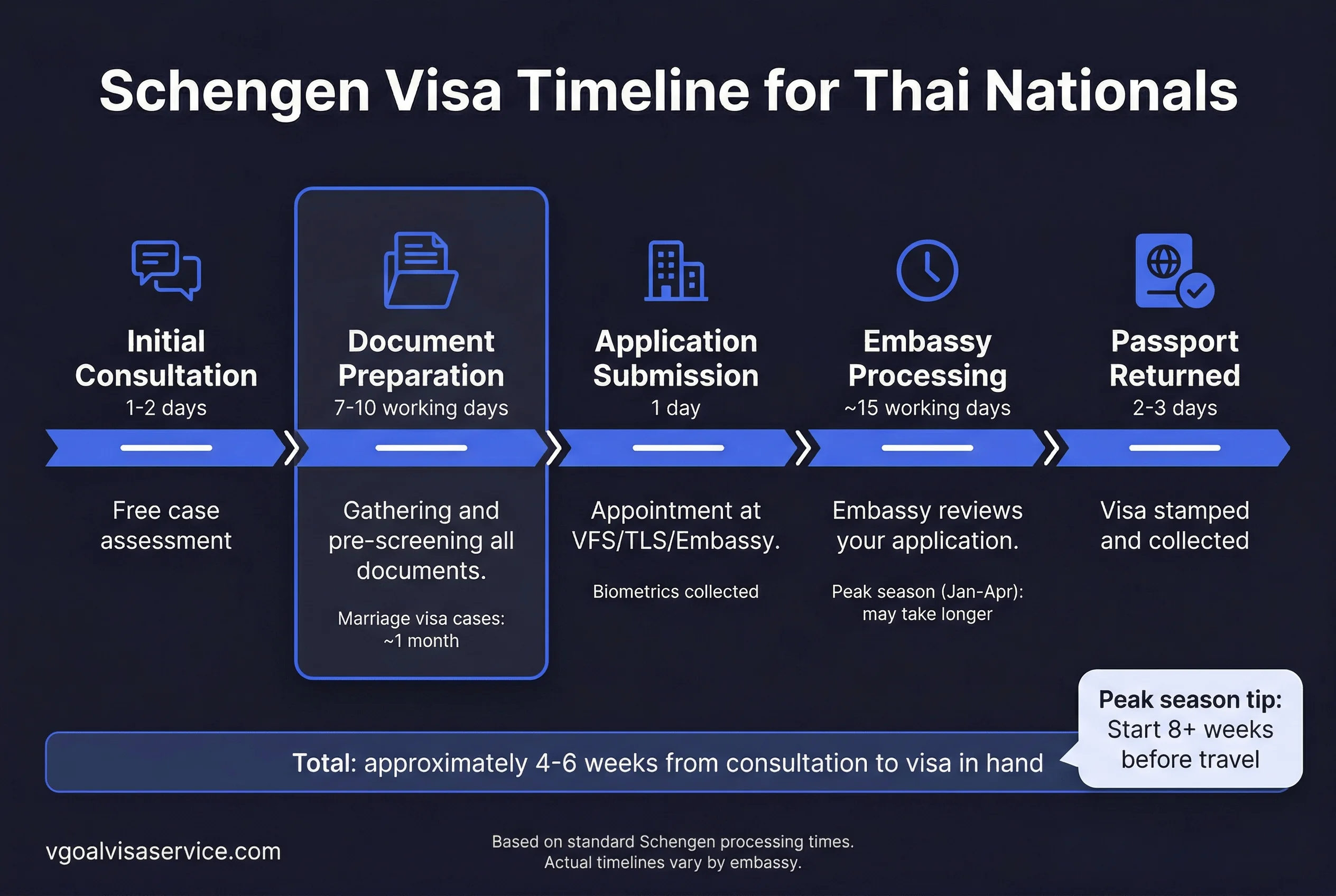
January through April is when we see the heaviest volume, as clients prepare for European summer travel and Songkran holidays. A second wave hits around June through August. Appointment slots at VFS Global and TLS Contact tighten during both windows, and processing times occasionally stretch. Applications can be submitted up to 180 days before the travel date, and there’s no advantage to waiting.
One detail that trips people up: the applicant must travel within the exact validity period printed on the visa. No flexibility on dates once it’s issued.
The Appointment: What to Expect at VFS or TLS
Your Thai partner will visit the visa application center (VFS Global or TLS Contact, depending on the destination country) at the scheduled time. The appointment typically takes 30-60 minutes. Staff will review the application package, collect biometric data (fingerprints from all 10 fingers and a digital photograph), and accept the documents for forwarding to the embassy.
This is not an interview. The staff at the application center are not making the visa decision. They check that the paperwork is complete and collect biometrics. The actual decision is made by consular officers at the embassy.
Some embassies do conduct separate interviews beyond the biometric appointment. Poland is the most common example in Bangkok, where applicants may be asked detailed questions about their personal circumstances, travel plans, and relationship. Sweden and France occasionally request interviews as well. When we know a client’s embassy is likely to interview, we run through preparation beforehand so there are no surprises.
Biometric data is stored for 59 months under current VIS rules. If your partner has given biometrics for a previous Schengen application within that window, they may not need to provide them again, though the application center appointment is still required.
What It Costs: A Realistic Breakdown
The Schengen visa fee for Thai nationals in 2026 is €90 for adults (approximately 3,500 THB) and €45 for children aged 6-12. In addition to the official embassy fee, applicants pay a VFS or TLS service center fee of 700-1,400 THB and Schengen-compliant travel insurance of 800-2,000 THB. Total out-of-pocket costs for a single adult typically start around 4,500 THB before professional preparation fees.
The headline visa fee is only part of the picture. Here’s what a Europe visa from Bangkok actually costs, as of early 2026:
| Cost Item (early 2026) | Amount |
|---|---|
| Schengen visa fee (adult) | €90 (~3,500 THB) |
| Schengen visa fee (child 6-12) | €45 (~1,750 THB) |
| VFS/TLS service center fee | 700-1,400 THB |
| Schengen-compliant travel insurance | 800-2,000 THB (varies by coverage and trip length) |
| Passport photos | 100-200 THB |
| Document translation (if needed) | 500-2,000 THB per document |
| Courier/mailing costs (invitation letter from Europe) | 500-1,500 THB |
That’s a lot of separate line items from different providers, in different currencies, with amounts that shift depending on the embassy and the specifics of the case. For a single adult, government and processing fees alone typically start around 4,500 THB and can reach 10,000 THB or more depending on the embassy and case specifics, before any professional preparation costs.
This is one of the things clients tell us they appreciate most about working with V Goal: we give you a single, all-in quote upfront. Our fee covers the full preparation service, and we walk you through every government and processing cost before you commit, so you know the complete picture from day one. No fees appearing halfway through, no “by the way” charges after you’ve already started. Contact us for a quote based on your specific situation.
Worth noting: the €90 visa fee is non-refundable regardless of the outcome. If the application is denied, that money is gone, which is why preparation quality matters more than any other cost in the process.
What If the Visa Is Denied?
The embassy will provide a written statement citing the specific grounds under Article 32 of the EU Visa Code.
There’s no mandatory cooling-off period. Your partner can reapply immediately. But submitting the same documents won’t produce a different result. The specific denial grounds need to be addressed directly. If the rejection cited “doubt regarding intention to return,” the reapplication needs new evidence of ties to Thailand, not just a larger bank balance.
When a client comes to us after a denial, we start by understanding exactly what the embassy flagged and whether those circumstances have changed. Sometimes the answer is that the situation needs a few months to strengthen before reapplying. That’s not always what people want to hear, but it’s better than rushing into another denial, which makes every future application harder.
If your Thai partner has been denied a Schengen visa, contact our team and we’ll review the refusal letter with you.
Building Your Schengen Travel History
A first Schengen visa is typically single-entry with a short validity.
Each successful trip builds your partner’s travel record. After three or more trips with clean entries and exits, embassies start issuing longer-validity visas: one year, then two, eventually up to five years with multiple-entry privileges. This cascade was formalized in the 2020 amendments to the EU Visa Code, so the progression is now a defined framework, not just informal embassy practice.
We help clients think beyond the immediate trip. The visa your partner is applying for now affects what’s available next year and the year after. A clean Schengen travel history is one of the strongest assets for any future visa application, not just for Europe but for the UK, Australia, and beyond.
This is part of why our Schengen visa services focus heavily on getting the first application right. A strong start sets the trajectory for years of easier travel.
Frequently Asked Questions
What is the Schengen visa rejection rate for Thai nationals?
As of 2024 European Commission data, the rejection rate for Thai nationals is 6.2%, well below the global average of 14.8%. But that headline number hides significant variation between embassies in Bangkok: the Austrian embassy rejects just 2.5% of Thai applications (2023 European Commission consulate-level data), while the Swedish embassy rejects 16.7%. The embassy you apply to matters.
How long does a Schengen visa take from Thailand?
Processing typically takes about 15 working days from the appointment date. Add 7-10 working days before that for document preparation, and potentially weeks before that for the invitation letter if a European sponsor is involved. Realistically, plan for 6-8 weeks from first contact to passport back, especially during peak season (January through April).
Why do Thai nationals get denied Schengen visas?
The most common denial reason for Thai applicants isn’t insufficient funds. An estimated 10% of East and Southeast Asian Schengen refusals cite insufficient funds, compared to 21% globally (HelloSafe Schengen Visa Refusal Barometer 2025, 2024 data). The real issue is doubt regarding the applicant’s intention to leave the Schengen area before the visa expires. The embassy assesses ties to Thailand (employment, property, family) to predict whether the applicant will return. “Unjustified travel purpose” is a separate ground that appears in about 13% of regional refusals (same source). Proving stable ties to Thailand matters more than the bank balance for most Thai applicants.
Which Schengen embassy in Bangkok has the highest approval rate?
Based on 2023 European Commission data, the Austrian embassy has the highest approval rate at 97.5%, followed by Switzerland at 97.3%. At the other end, Sweden sits at 83.3%. All embassies apply the same EU Visa Code but interpret it differently, which is why the same applicant can have very different odds depending on where they apply.
How much money do I need in my bank account for a Schengen visa?
There’s no single answer. Financial expectations vary significantly between embassies. Some are satisfied with savings that match your income and lifestyle. Others, particularly in Northern Europe, set the bar considerably higher. What matters more than any specific number is consistency: six months of regular salary deposits and normal spending patterns. A large lump sum that appears just before the application raises more suspicion than it resolves.
Can I visit non-Schengen EU countries like Ireland or Cyprus with a Schengen visa?
No. The Schengen visa covers only the 29 member states listed above. Ireland, Cyprus, and the UK each require separate visa applications with different requirements and processing timelines.
What if my Thai partner is visiting multiple Schengen countries for equal time?
Apply to the embassy of the country of first entry. This is a nuance we work through during consultation. The itinerary needs to clearly support whichever embassy receives the application.
How far in advance can we apply?
Up to 180 days (six months) before the travel date. We recommend starting the preparation process 2-3 months out to allow time for document gathering, invitation letter coordination, and appointment scheduling, especially during peak season.
Does my Thai partner need to attend an interview?
Biometric data collection (fingerprints and photograph) is required in person at the visa application center. Most embassies don’t conduct separate interviews beyond this. Some do, particularly Poland, which tends to focus heavily on the applicant’s personal circumstances. We provide interview preparation as part of our service.
What are the Schengen visa requirements for Thai citizens in 2026?
Thai citizens need a valid passport, Schengen travel insurance (minimum €30,000 coverage), six months of bank statements, an employment letter, proof of ties to Thailand, round-trip flight bookings, accommodation confirmation, and a day-by-day itinerary. The visa fee is €90 for adults. If visiting someone in Europe, an invitation letter from the European sponsor is also required. Specific embassies may request additional documents; requirements vary by country.
Every Schengen application has its own circumstances: the destination, the relationship, the documents, the timeline. If you’re planning a trip to Europe with your Thai partner, we’d like to understand your situation first so we can advise you on the best way to proceed.
Whether you’re the Thai applicant or the European partner, you can reach us on LINE, WhatsApp, or through our contact page. We’ll talk through your situation and let you know what’s involved before you commit to anything.